What those DNS records do
Verifying a sending domain asks you to publish several DNS records. In plain words:
SPF is a public list of who is allowed to send email using your domain. Without it, a receiving server has no way to tell your broadcast apart from someone forging your address.
DKIM signs each message cryptographically, so a receiving server can prove the message really came from your domain and was not altered on the way.
A tracking record lets link clicks and opens be attributed back to your domain rather than a generic one.
You do not need to understand the syntax. You do need every record published exactly as the settings page shows, and the tracking CNAME left unproxied if your DNS provider proxies traffic.
Where the deliverability check lives
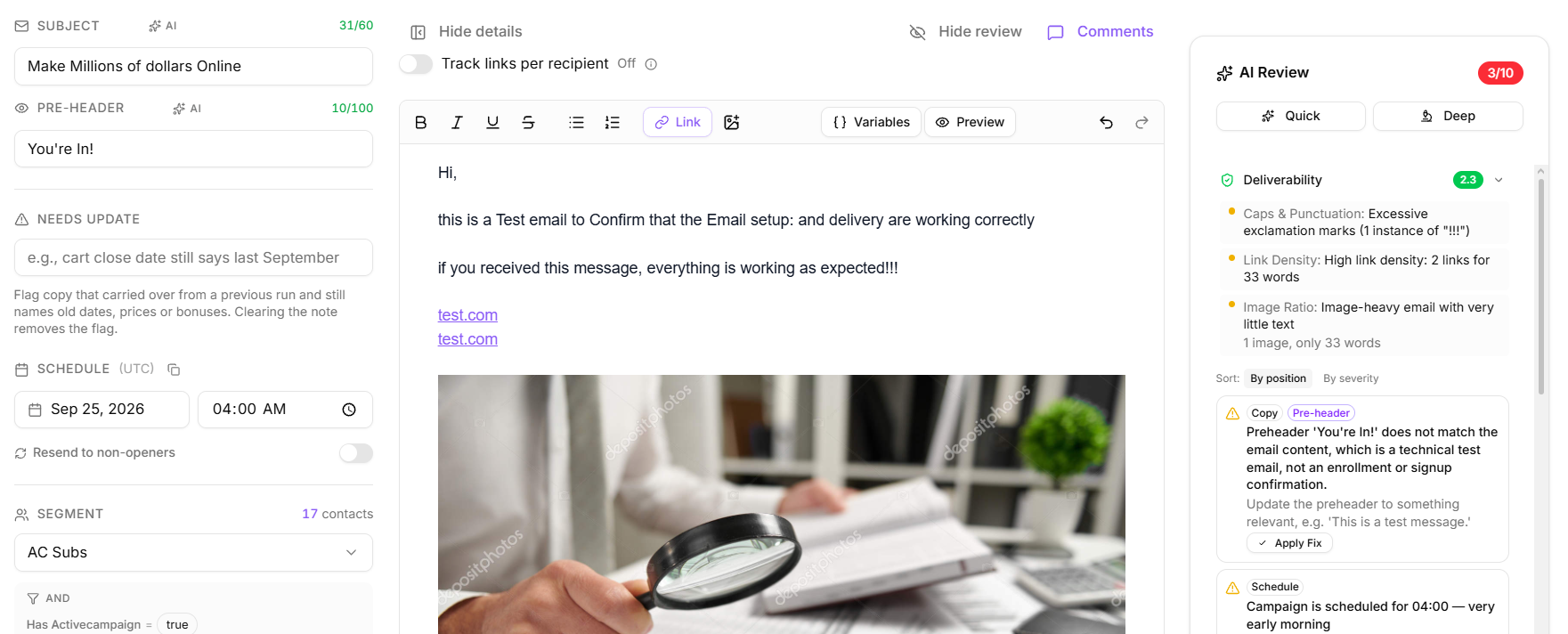
Deliverability is a spam-risk score, and it is not a panel of its own. It sits at the top of the AI review panel, so you reach it the same way you reach the review:
Open the campaign and move it to Review status. Before that, in Draft, the review panel does not exist and neither does the score.
In the editor header, select Show review. The panel opens on the right, with Deliverability at the top of it. Hide review closes it again.
The score covers:
Trigger Words
Caps & Punctuation
Link Density
Image Ratio
Formatting
Subject Line
Best Practices
It says "No deliverability issues" when it is happy. Treat a flag as a question rather than a verdict: one trigger word in a legitimate sales email is fine, while a subject in capitals with three exclamation marks is not.
Deliverability at the top of the AI review panel
Warming up a new domain
A brand new sending domain has no reputation. Mailbox providers treat a sudden large volume from an unknown domain with suspicion, so build up gradually.
Start with your most engaged recipients: recent buyers, people who opened something in the last 30 days. Build a segment for exactly that.
Send small at first and increase volume over days rather than hours.
Watch complaints and bounces after each send. If either jumps, stop increasing volume until you know why.
Only mail your full list once several sends have gone out cleanly.
Engagement is what builds reputation. Sending your best content to your most engaged people first is not a trick; it is the whole mechanism.
Habits that keep delivery healthy
Send consistently. Long silences followed by a big campaign look like a compromised account.
Never buy a list. Bought addresses produce complaints and spam-trap hits, and the damage lands on your domain.
Let unsubscribes happen easily. A hard-to-find unsubscribe link converts people who would have quietly left into complaints.
Clean up hard bounces rather than retrying them. KeyMetriq does this for you by adding them to the suppression list.